



















Introduction
For most SUVs in India — Fortuner, Thar, Hilux — the best winch for SUV in India starts with a single calculation: 1.5× your vehicle's Gross Vehicle Weight (GVW). Get that number right, match it to an electric winch with an IP67 or IP68 rating, and you have the backbone of a reliable self-recovery setup for any Indian terrain.
The practical case for a winch is straightforward. A Thar axle-deep in Karnataka hill mud during July monsoon, a Fortuner high-centred on a Spiti boulder field, or a Hilux buried in a Rajasthan sand hollow with the nearest town 40 kilometres away — in each situation, a correctly-sized winch is the difference between a ten-minute self-rescue and a multi-hour wait for another vehicle.
The wrong winch — undersized, poorly rated for water, or badly installed — gives you false confidence. This guide exists to prevent that. It covers capacity calculation, electric versus hydraulic comparison, terrain-specific considerations, rope type selection, snatch block setup, battery requirements, and what to verify before any winch goes on your vehicle.
Why Do You Need a Winch for Your SUV in India?
India's off-road terrain is uniquely seasonal and hazardous. The Western Ghats become sheets of clay-mud from June to September. Rajasthan and Gujarat present deep sand that swallows vehicles in seconds. Ladakh, Spiti, and Uttarakhand combine gradient, loose shale, and glacial river crossings. Forest tracks in Kerala, Coorg, and Araku Valley turn treacherous after rainfall regardless of how mild they look on the map. The 4x4 specialists at Swastik Fabs, Bangalore see the consequences of under-preparation first-hand — and a missing winch is the most common one.
Self-recovery is the core argument. Trail driving in India frequently happens without mobile signal, sometimes solo, and often far from any settlement. A winch anchored to a tree, a rock, or a sand anchor pulls your vehicle free on your timeline — not someone else's schedule.
3 Real Indian Off-Road Scenarios Where a Winch Is the Deciding Factor
Western Ghats, Karnataka, August: A solo driver on a forest track near Coorg hits a waterlogged section after heavy rain. The clay soil, saturated to 30 cm depth, grips all four wheels completely — the vehicle sits level with no angle to exploit. Mobile signal: absent. Nearest village: 12 km back. With a 9,500 lb winch and a tree trunk protector on the nearest large tree, recovery takes under 10 minutes. Without one: three to four hours of digging and waiting.
Jaisalmer Desert, Rajasthan, December: A Fortuner crests a dune and drops its nose into soft sand on the lee side, burying the front axle at a 25-degree downward angle. Rear wheels have no traction because the drivetrain is carrying the full nose load. A winch anchored to a portable sand plate anchor pulls the nose forward. No winch: the standard fix is digging out the front axle by hand — typically 45 to 90 minutes in loose desert sand.
Spiti Valley, Himachal Pradesh, July: A Hilux stalls mid-crossing on a glacial meltwater stream at 4,200 m altitude. Cold water, reduced engine output at altitude, and a rocky bottom make restart attempts risky. A winch line to the opposite bank holds the vehicle stable while the engine is restarted — preventing current drag from rotating the vehicle sideways. At altitude, below 10°C, with no phone signal, a winch is not optional equipment.
Types of Winches: Electric vs Hydraulic
Two technologies dominate the winch market. The decision for most Indian SUV owners is not difficult, but understanding why electric wins for most use cases prevents expensive mistakes at the point of purchase.
The electric winch recommendation for Indian conditions is clear: IP67 or IP68-rated electric winches handle monsoon water crossings, dust, and mud without hydraulic line complexity. They operate with a stalled engine — critical when your vehicle dies mid-water crossing. And the total installation cost of hydraulic systems on an Indian SUV platform makes them practical only for operators who use recovery winches daily.
For owners who want recovery capability without a permanent bumper-mount setup, the best portable electric winch options use removable receiver-hitch mounts (2-inch hitch receiver) or bolt-on plate systems that detach cleanly. These allow one winch to transfer between two vehicles or be stored when not in use — useful for families with a secondary on-road vehicle. Portable-mount winches of 9,500–12,000 lb capacity are available in India and follow the same 1.5× GVW capacity rule as fixed-mount units. The trade-off: receiver-hitch mounts add flex under load compared to a welded bumper plate, making them better suited to moderate terrain than extreme recovery.
How to Choose the Right Winch for Your SUV — India-Specific Guide

5-Step Selection Checklist
Find your vehicle's GVW from the Registration Certificate (RC) or owner's manual — not the kerb weight. GVW includes the vehicle, passengers, fuel, and maximum load.
Apply the 1.5× rule: GVW × 1.5 = minimum winch capacity in kg. Convert to lbs (1 kg = 2.205 lbs) to match winch product ratings.
Add a terrain buffer: add 10–15% to your calculated minimum if you regularly drive deep sand or steep inclines where pull angle increases effective load.
Choose IP67 minimum for any Indian use — IP68 if you regularly do water crossings deeper than 1 metre.
Decide on rope type: synthetic rope (UHMWPE) for safety and handling; steel cable if rocky terrain abrasion is the primary concern.
What a Snatch Block Does — and Why You Need One in Your Recovery Kit
A snatch block is a single-pulley system in a rated steel or aluminium housing. When you route the winch rope through a snatch block anchored to a fixed point and double it back to your vehicle, the physics change significantly: the load on the winch motor drops by approximately 50%, and the effective pulling force at the vehicle nearly doubles.
A 9,500 lb winch rigged through a snatch block can apply close to 18,000 lbs of effective pull — enough to free a heavily loaded Fortuner from deep mud where a single-line pull would stall the motor or trigger thermal cut-off. Snatch blocks are rated in tonnes; always use a block rated above your winch's maximum single-line pull. Browse the
For Indian off-road conditions — particularly deep monsoon clay where suction resistance adds significantly to the load — a snatch block setup converts a marginal recovery into a clean one. Buy it when you buy the winch.
What Size Winch for Fortuner and Other Popular SUVs?
The best winch for Fortuner and Hilux starts at 10,000 lbs. The best winch for Thar starts at 9,500 lbs. Here is the complete calculation for five popular Indian off-road vehicles, based on published GVW data from Toyota Bharat and Mahindra India:
One practical note on accessories: if your vehicle carries a roof tent, heavy recovery kit, water cans, or a steel canopy — accessories that add 50–200 kg — go one step above the base calculation. A loaded Fortuner on a Himachal expedition justifies a 12,000 lb winch where a stock Fortuner is technically covered at 10,000 lb.
Essential Features to Look for in Heavy-Duty Winches
6 Features That Separate Trail-Ready Winches from Shelf Fillers
IP68 sealing (minimum IP67): Indian monsoon seasons and river crossings demand it. A winch rated below IP67 will fail at the moment you need it most — mid-water crossing.
Motor type — series-wound vs permanent magnet: Series-wound motors tolerate sustained heavy loads and heat better. Permanent magnet motors are lighter and adequate for moderate, intermittent use. For serious off-roading, series-wound is worth the premium.
Line speed: Faster line retrieval (metres per minute at no-load) reduces wait time on recovery. Look for a minimum of 10–15 m/min no-load speed. Slow line speed is noticeable and frustrating in a real recovery situation.
Automatic load-holding brake: The brake must hold the vehicle stationary mid-pull without the motor running. Non-negotiable for slope recovery — the vehicle must stay put when you release line tension to re-rig or reposition.
Thermal protection cut-off: Any winch intended for Indian rocky or clay terrain — where a single recovery pull may last 30–90 seconds — must have automatic thermal shutdown to protect the motor. Without it, sustained pulling burns out the motor.
Fairlead compatibility: A hawse fairlead (smooth aluminium opening) is designed for synthetic rope. A roller fairlead is designed for steel cable. Pairing the wrong fairlead with your rope type accelerates wear on both rope and fairlead within a single season of use.
Best Winch Options for Popular SUVs in India
Rather than recommending specific models — which change with import availability, exchange rates, and duty structures — the segment-based framework gives you a durable decision logic. Browse the full range of
* Price estimates are approximate Indian market figures as of May 2026. Prices vary by retailer, model, rope type, and import duty. Confirm current pricing directly with the supplier before purchase.
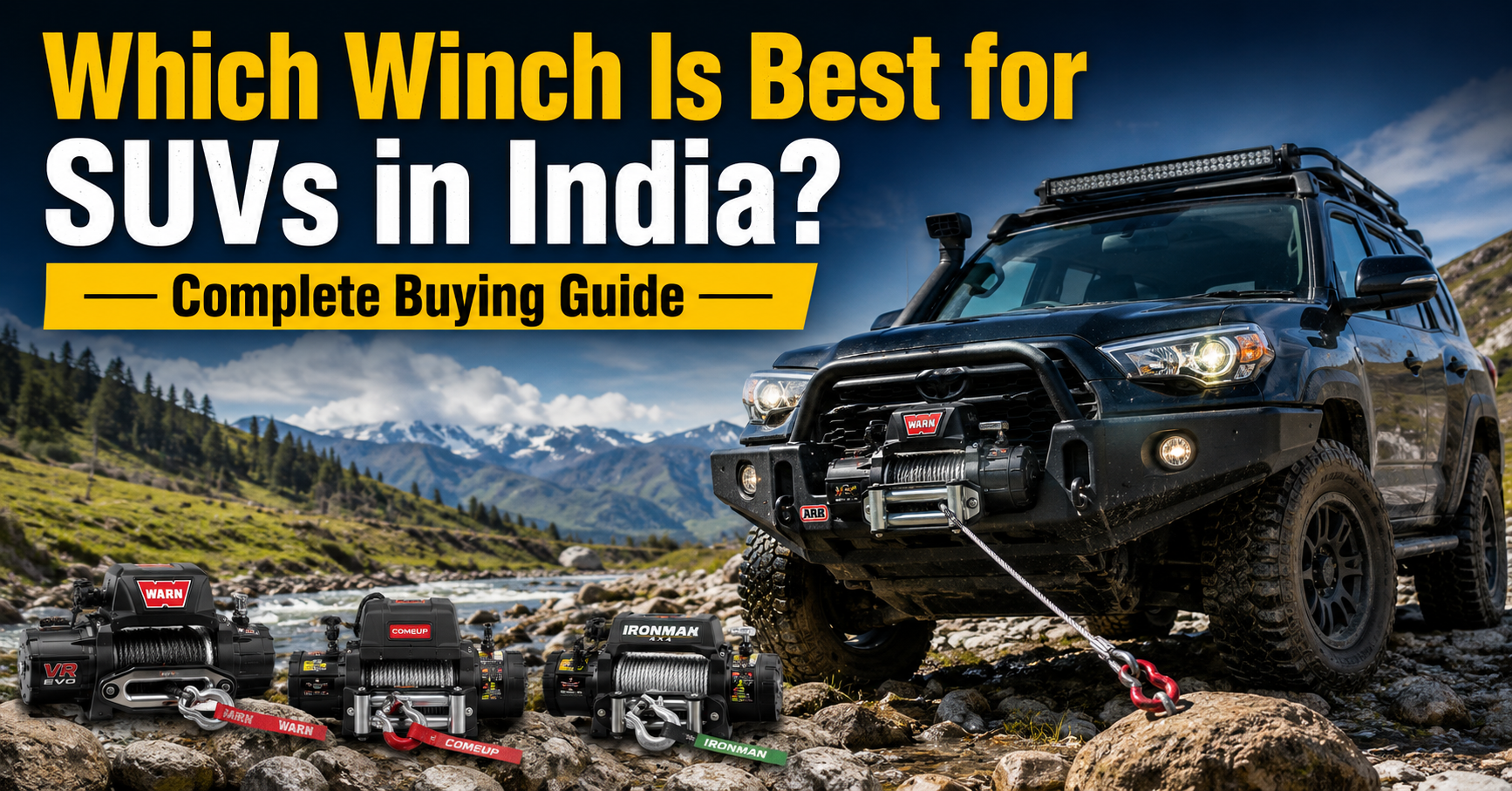
Brands currently available in India across these segments include Warn, Runva, Comeup, Dragon Winch, Warrior Winch, and Mile Marker. Warn is the global benchmark for off-road winch reliability and sits at the top of the premium segment. Runva and Comeup deliver dependable mid-range performance and are frequent fitments on
Where to Buy the Best Winch for SUVs in India
The winch purchase and the winch installation are two decisions that belong together. Buying a correctly-specified winch and installing it on the wrong bumper, or with undersized wiring, produces a system that underperforms or damages your vehicle. The supplier should answer not just which winch fits, but how it mounts to your specific vehicle, what electrical upgrades are needed, and what bumper configuration supports the load.
Swastik Fabs is a 4x4 vehicle fabrication and accessories specialist in Bangalore, with installation capability across winch fitments,
The practical value of a specialist installer over a generic auto accessories retailer: a specialist verifies bumper load rating before fitment, sizes the power cable correctly for the winch's rated amperage draw (typically 400–500A at peak load per manufacturer data sheets), and positions the solenoid box away from water ingress points. These are not details visible in an unboxing video.
→ Off-road accessories and winch fitment — Swastik Fabs Bangalore
→ 4x4 build consultation and custom fabrication enquiry
Installation and Safety Tips
3 Installation Requirements That Determine Winch Performance
Bumper compatibility: Most factory bumpers on Indian SUVs are not rated for winch loads. A winch exerts several tonnes of pull force on its mounting point. A custom steel bumper with a winch plate rated above the winch's maximum line pull is the correct foundation — see Swastik Fabs' range of platform-specific bumper solutions.
Electrical system sizing: A 9,500–12,000 lb electric winch draws 350–500 amps at peak load per manufacturer specifications. The cable from battery to winch must be rated for that amperage — typically 2/0 AWG or 4/0 AWG. Undersized cable causes voltage drop, motor torque loss, and fire risk.
Solenoid box placement: The solenoid (control relay between battery and winch motor) must be mounted in a waterproofed location, away from heat sources, with the housing accessible for periodic inspection and servicing.
When to Upgrade Your Battery Before Installing a Winch
Stock vehicle batteries in most Indian SUVs — the Fortuner, Thar, and Hilux all ship with 60–80 Ah units — are sized for engine starting and standard electrical loads. At a 9,500–12,000 lb winch's peak amperage draw, sustained pulling drops battery voltage sharply, reducing motor torque and potentially preventing engine restart once the recovery is complete.
For occasional short-duration pulls on a healthy alternator, stock batteries handle the load adequately. For drivers anticipating repeated recoveries — deep mud, solo expedition, high-altitude terrain — a dedicated secondary battery for the winch is the right solution.
Practical setup: a deep-cycle AGM battery (100–120 Ah) wired as a secondary unit through a DC-DC charger or battery isolator. The isolator prevents the winch from draining the primary starting battery during a recovery. This dual-battery configuration is standard on serious Fortuner and Hilux expedition builds in India and is available as part of a full
4 Safe Operation Rules — Every Pull
Never stand in the direct line of a tensioned cable or rope. If the line fails, the kill zone extends the full rope length in both directions.
Use a rope dampener — a weighted recovery bag or purpose-made dampener draped over the rope mid-pull. If the rope fails, the dampener kills the recoil.
Never attach the winch hook directly back to the rope. Always use a rated recovery shackle and a tree trunk protector for anchor points.
Wear gloves when handling steel cable. Even minor kinks create sharp wire projections that cut through skin on contact.
Maintenance Tips for Off-Road Winches
A winch used once and ignored will fail on the next use. Post-trail maintenance is a 15-minute routine that protects a INR 50,000–1,50,000 investment.
After Every Off-Road Use
Spool the rope or cable out fully and wash with fresh water — removing mud, sand, and salt before re-spooling prevents abrasion and corrosion buildup inside the drum.
Inspect the rope along its full length: synthetic rope for fraying or UV discolouration; steel cable for kinks, broken strands, or rust spots.
Check all electrical connections at battery terminals, solenoid housing, and motor lead for corrosion. Apply dielectric grease to all exposed contacts.
Verify fairlead rollers (if fitted) rotate freely. Flat spots on rollers damage rope on re-spooling.
Every 3–6 Months
Re-grease the drum shaft bearing per manufacturer specification.
Test the winch under no-load in both directions to confirm motor and solenoid function.
Check all mounting hardware torque — off-road vibration loosens fasteners progressively.
Conclusion
The best winch for your SUV is not the biggest one available — it is the one correctly sized for your vehicle's GVW, rated for your terrain type and IP class, installed on a bumper that can handle the load, and wired to a battery system that can sustain the amperage. For most Indian SUV owners on Fortuner, Thar, or Hilux platforms, a mid-range electric winch rated 9,500–12,000 lb with IP67 minimum and a snatch block in the recovery kit covers the full range of Indian trail conditions.
Buying right and installing right are equally weighted decisions. Consult a 4x4 specialist before committing — bumper compatibility, cable sizing, and solenoid placement are not details you can retrofit cheaply.
Ready to fit a winch to your SUV? Swastik Fabs provides 4x4 winch consultation, custom bumper fabrication, and professional installation in Bangalore. Visit swastikfabs.in to enquire about your specific vehicle and get a fitment quote.
Frequently Asked Questions About Winches
Q1: What is the best winch capacity for SUVs in India?
The rule is 1.5× your vehicle's GVW from the Registration Certificate — not the kerb weight. Per Toyota Bharat's published specifications, the Fortuner GVW is 3,175 kg, requiring a 10,000–12,000 lb winch. Per Mahindra's published specifications, the Thar GVW is 2,570 kg, requiring a 9,500 lb minimum. Add 10–15% if your vehicle carries significant accessories or expedition equipment.
Q2: Is an electric winch better than a hydraulic winch for Indian conditions?
For most Indian SUV owners, yes. Electric winches with IP67 or IP68 ratings handle monsoon exposure well and operate with the engine off — critical when a vehicle stalls mid-water crossing. Hydraulic winches suit commercial operators and expedition rigs needing sustained pulling power. For recreational off-roaders, the installation complexity and cost of hydraulic systems provides no practical benefit.
Q3: Which is better for off-roading in India: steel cable or synthetic rope?
Synthetic rope (UHMWPE) is safer and the preferred choice for Indian trail conditions. If it breaks under load, it drops to the ground instead of snapping back like steel cable. Steel cable is cheaper and more abrasion-resistant on rocky terrain but rusts in monsoon use and is dangerous around kinks or damaged strands. Always use a rope dampener regardless of rope type.
Q4: Do I need a winch for my SUV in India?
If you drive off-road solo — Western Ghats monsoon tracks, Rajasthan sand, Ladakh boulder fields, or any route without mobile signal where a stuck vehicle means an extended wait — a winch is the most effective self-recovery tool available. For strictly on-road use, a winch is unnecessary. For off-road use in remote terrain, it is the most important safety equipment on the vehicle after the spare tyre.
Q5: How much does a good off-road winch cost in India?
A reliable mid-range electric winch for regular Indian off-road use costs approximately INR 35,000–70,000. Budget options start from INR 15,000–30,000 but typically carry lower IP ratings and shorter motor life. Premium winches run INR 80,000–1,50,000 plus. Professional installation adds INR 3,000–10,000 depending on bumper type and electrical work required. Add INR 1,500–5,000 for a snatch block — the most valuable recovery accessory after the winch itself. All figures are market estimates as of May 2026.
Introduction
For most SUVs in India — Fortuner, Thar, Hilux — the best winch for SUV in India starts with a single calculation: 1.5× your vehicle's Gross Vehicle Weight (GVW). Get that number right, match it to an electric winch with an IP67 or IP68 rating, and you have the backbone of a reliable self-recovery setup for any Indian terrain.
The practical case for a winch is straightforward. A Thar axle-deep in Karnataka hill mud during July monsoon, a Fortuner high-centred on a Spiti boulder field, or a Hilux buried in a Rajasthan sand hollow with the nearest town 40 kilometres away — in each situation, a correctly-sized winch is the difference between a ten-minute self-rescue and a multi-hour wait for another vehicle.
The wrong winch — undersized, poorly rated for water, or badly installed — gives you false confidence. This guide exists to prevent that. It covers capacity calculation, electric versus hydraulic comparison, terrain-specific considerations, rope type selection, snatch block setup, battery requirements, and what to verify before any winch goes on your vehicle.
Why Do You Need a Winch for Your SUV in India?
India's off-road terrain is uniquely seasonal and hazardous. The Western Ghats become sheets of clay-mud from June to September. Rajasthan and Gujarat present deep sand that swallows vehicles in seconds. Ladakh, Spiti, and Uttarakhand combine gradient, loose shale, and glacial river crossings. Forest tracks in Kerala, Coorg, and Araku Valley turn treacherous after rainfall regardless of how mild they look on the map. The 4x4 specialists at Swastik Fabs, Bangalore see the consequences of under-preparation first-hand — and a missing winch is the most common one.
Self-recovery is the core argument. Trail driving in India frequently happens without mobile signal, sometimes solo, and often far from any settlement. A winch anchored to a tree, a rock, or a sand anchor pulls your vehicle free on your timeline — not someone else's schedule.
3 Real Indian Off-Road Scenarios Where a Winch Is the Deciding Factor
Western Ghats, Karnataka, August: A solo driver on a forest track near Coorg hits a waterlogged section after heavy rain. The clay soil, saturated to 30 cm depth, grips all four wheels completely — the vehicle sits level with no angle to exploit. Mobile signal: absent. Nearest village: 12 km back. With a 9,500 lb winch and a tree trunk protector on the nearest large tree, recovery takes under 10 minutes. Without one: three to four hours of digging and waiting.
Jaisalmer Desert, Rajasthan, December: A Fortuner crests a dune and drops its nose into soft sand on the lee side, burying the front axle at a 25-degree downward angle. Rear wheels have no traction because the drivetrain is carrying the full nose load. A winch anchored to a portable sand plate anchor pulls the nose forward. No winch: the standard fix is digging out the front axle by hand — typically 45 to 90 minutes in loose desert sand.
Spiti Valley, Himachal Pradesh, July: A Hilux stalls mid-crossing on a glacial meltwater stream at 4,200 m altitude. Cold water, reduced engine output at altitude, and a rocky bottom make restart attempts risky. A winch line to the opposite bank holds the vehicle stable while the engine is restarted — preventing current drag from rotating the vehicle sideways. At altitude, below 10°C, with no phone signal, a winch is not optional equipment.
Types of Winches: Electric vs Hydraulic
Two technologies dominate the winch market. The decision for most Indian SUV owners is not difficult, but understanding why electric wins for most use cases prevents expensive mistakes at the point of purchase.
The electric winch recommendation for Indian conditions is clear: IP67 or IP68-rated electric winches handle monsoon water crossings, dust, and mud without hydraulic line complexity. They operate with a stalled engine — critical when your vehicle dies mid-water crossing. And the total installation cost of hydraulic systems on an Indian SUV platform makes them practical only for operators who use recovery winches daily.
For owners who want recovery capability without a permanent bumper-mount setup, the best portable electric winch options use removable receiver-hitch mounts (2-inch hitch receiver) or bolt-on plate systems that detach cleanly. These allow one winch to transfer between two vehicles or be stored when not in use — useful for families with a secondary on-road vehicle. Portable-mount winches of 9,500–12,000 lb capacity are available in India and follow the same 1.5× GVW capacity rule as fixed-mount units. The trade-off: receiver-hitch mounts add flex under load compared to a welded bumper plate, making them better suited to moderate terrain than extreme recovery.
How to Choose the Right Winch for Your SUV — India-Specific Guide
5-Step Selection Checklist
Find your vehicle's GVW from the Registration Certificate (RC) or owner's manual — not the kerb weight. GVW includes the vehicle, passengers, fuel, and maximum load.
Apply the 1.5× rule: GVW × 1.5 = minimum winch capacity in kg. Convert to lbs (1 kg = 2.205 lbs) to match winch product ratings.
Add a terrain buffer: add 10–15% to your calculated minimum if you regularly drive deep sand or steep inclines where pull angle increases effective load.
Choose IP67 minimum for any Indian use — IP68 if you regularly do water crossings deeper than 1 metre.
Decide on rope type: synthetic rope (UHMWPE) for safety and handling; steel cable if rocky terrain abrasion is the primary concern.
What a Snatch Block Does — and Why You Need One in Your Recovery Kit
A snatch block is a single-pulley system in a rated steel or aluminium housing. When you route the winch rope through a snatch block anchored to a fixed point and double it back to your vehicle, the physics change significantly: the load on the winch motor drops by approximately 50%, and the effective pulling force at the vehicle nearly doubles.
A 9,500 lb winch rigged through a snatch block can apply close to 18,000 lbs of effective pull — enough to free a heavily loaded Fortuner from deep mud where a single-line pull would stall the motor or trigger thermal cut-off. Snatch blocks are rated in tonnes; always use a block rated above your winch's maximum single-line pull. Browse the
For Indian off-road conditions — particularly deep monsoon clay where suction resistance adds significantly to the load — a snatch block setup converts a marginal recovery into a clean one. Buy it when you buy the winch.
What Size Winch for Fortuner and Other Popular SUVs?
The best winch for Fortuner and Hilux starts at 10,000 lbs. The best winch for Thar starts at 9,500 lbs. Here is the complete calculation for five popular Indian off-road vehicles, based on published GVW data from Toyota Bharat and Mahindra India:
One practical note on accessories: if your vehicle carries a roof tent, heavy recovery kit, water cans, or a steel canopy — accessories that add 50–200 kg — go one step above the base calculation. A loaded Fortuner on a Himachal expedition justifies a 12,000 lb winch where a stock Fortuner is technically covered at 10,000 lb.
Essential Features to Look for in Heavy-Duty Winches
6 Features That Separate Trail-Ready Winches from Shelf Fillers
IP68 sealing (minimum IP67): Indian monsoon seasons and river crossings demand it. A winch rated below IP67 will fail at the moment you need it most — mid-water crossing.
Motor type — series-wound vs permanent magnet: Series-wound motors tolerate sustained heavy loads and heat better. Permanent magnet motors are lighter and adequate for moderate, intermittent use. For serious off-roading, series-wound is worth the premium.
Line speed: Faster line retrieval (metres per minute at no-load) reduces wait time on recovery. Look for a minimum of 10–15 m/min no-load speed. Slow line speed is noticeable and frustrating in a real recovery situation.
Automatic load-holding brake: The brake must hold the vehicle stationary mid-pull without the motor running. Non-negotiable for slope recovery — the vehicle must stay put when you release line tension to re-rig or reposition.
Thermal protection cut-off: Any winch intended for Indian rocky or clay terrain — where a single recovery pull may last 30–90 seconds — must have automatic thermal shutdown to protect the motor. Without it, sustained pulling burns out the motor.
Fairlead compatibility: A hawse fairlead (smooth aluminium opening) is designed for synthetic rope. A roller fairlead is designed for steel cable. Pairing the wrong fairlead with your rope type accelerates wear on both rope and fairlead within a single season of use.
Best Winch Options for Popular SUVs in India
Rather than recommending specific models — which change with import availability, exchange rates, and duty structures — the segment-based framework gives you a durable decision logic. Browse the full range of
* Price estimates are approximate Indian market figures as of May 2026. Prices vary by retailer, model, rope type, and import duty. Confirm current pricing directly with the supplier before purchase.
Brands currently available in India across these segments include Warn, Runva, Comeup, Dragon Winch, Warrior Winch, and Mile Marker. Warn is the global benchmark for off-road winch reliability and sits at the top of the premium segment. Runva and Comeup deliver dependable mid-range performance and are frequent fitments on
Where to Buy the Best Winch for SUVs in India
The winch purchase and the winch installation are two decisions that belong together. Buying a correctly-specified winch and installing it on the wrong bumper, or with undersized wiring, produces a system that underperforms or damages your vehicle. The supplier should answer not just which winch fits, but how it mounts to your specific vehicle, what electrical upgrades are needed, and what bumper configuration supports the load.
Swastik Fabs is a 4x4 vehicle fabrication and accessories specialist in Bangalore, with installation capability across winch fitments,
The practical value of a specialist installer over a generic auto accessories retailer: a specialist verifies bumper load rating before fitment, sizes the power cable correctly for the winch's rated amperage draw (typically 400–500A at peak load per manufacturer data sheets), and positions the solenoid box away from water ingress points. These are not details visible in an unboxing video.
→ Off-road accessories and winch fitment — Swastik Fabs Bangalore
→ 4x4 build consultation and custom fabrication enquiry
Installation and Safety Tips
3 Installation Requirements That Determine Winch Performance
Bumper compatibility: Most factory bumpers on Indian SUVs are not rated for winch loads. A winch exerts several tonnes of pull force on its mounting point. A custom steel bumper with a winch plate rated above the winch's maximum line pull is the correct foundation — see Swastik Fabs' range of platform-specific bumper solutions.
Electrical system sizing: A 9,500–12,000 lb electric winch draws 350–500 amps at peak load per manufacturer specifications. The cable from battery to winch must be rated for that amperage — typically 2/0 AWG or 4/0 AWG. Undersized cable causes voltage drop, motor torque loss, and fire risk.
Solenoid box placement: The solenoid (control relay between battery and winch motor) must be mounted in a waterproofed location, away from heat sources, with the housing accessible for periodic inspection and servicing.
When to Upgrade Your Battery Before Installing a Winch
Stock vehicle batteries in most Indian SUVs — the Fortuner, Thar, and Hilux all ship with 60–80 Ah units — are sized for engine starting and standard electrical loads. At a 9,500–12,000 lb winch's peak amperage draw, sustained pulling drops battery voltage sharply, reducing motor torque and potentially preventing engine restart once the recovery is complete.
For occasional short-duration pulls on a healthy alternator, stock batteries handle the load adequately. For drivers anticipating repeated recoveries — deep mud, solo expedition, high-altitude terrain — a dedicated secondary battery for the winch is the right solution.
Practical setup: a deep-cycle AGM battery (100–120 Ah) wired as a secondary unit through a DC-DC charger or battery isolator. The isolator prevents the winch from draining the primary starting battery during a recovery. This dual-battery configuration is standard on serious Fortuner and Hilux expedition builds in India and is available as part of a full
4 Safe Operation Rules — Every Pull
Never stand in the direct line of a tensioned cable or rope. If the line fails, the kill zone extends the full rope length in both directions.
Use a rope dampener — a weighted recovery bag or purpose-made dampener draped over the rope mid-pull. If the rope fails, the dampener kills the recoil.
Never attach the winch hook directly back to the rope. Always use a rated recovery shackle and a tree trunk protector for anchor points.
Wear gloves when handling steel cable. Even minor kinks create sharp wire projections that cut through skin on contact.
Maintenance Tips for Off-Road Winches
A winch used once and ignored will fail on the next use. Post-trail maintenance is a 15-minute routine that protects a INR 50,000–1,50,000 investment.
After Every Off-Road Use
Spool the rope or cable out fully and wash with fresh water — removing mud, sand, and salt before re-spooling prevents abrasion and corrosion buildup inside the drum.
Inspect the rope along its full length: synthetic rope for fraying or UV discolouration; steel cable for kinks, broken strands, or rust spots.
Check all electrical connections at battery terminals, solenoid housing, and motor lead for corrosion. Apply dielectric grease to all exposed contacts.
Verify fairlead rollers (if fitted) rotate freely. Flat spots on rollers damage rope on re-spooling.
Every 3–6 Months
Re-grease the drum shaft bearing per manufacturer specification.
Test the winch under no-load in both directions to confirm motor and solenoid function.
Check all mounting hardware torque — off-road vibration loosens fasteners progressively.
Conclusion
The best winch for your SUV is not the biggest one available — it is the one correctly sized for your vehicle's GVW, rated for your terrain type and IP class, installed on a bumper that can handle the load, and wired to a battery system that can sustain the amperage. For most Indian SUV owners on Fortuner, Thar, or Hilux platforms, a mid-range electric winch rated 9,500–12,000 lb with IP67 minimum and a snatch block in the recovery kit covers the full range of Indian trail conditions.
Buying right and installing right are equally weighted decisions. Consult a 4x4 specialist before committing — bumper compatibility, cable sizing, and solenoid placement are not details you can retrofit cheaply.
Ready to fit a winch to your SUV? Swastik Fabs provides 4x4 winch consultation, custom bumper fabrication, and professional installation in Bangalore. Visit swastikfabs.in to enquire about your specific vehicle and get a fitment quote.
Frequently Asked Questions About Winches
Q1: What is the best winch capacity for SUVs in India?
The rule is 1.5× your vehicle's GVW from the Registration Certificate — not the kerb weight. Per Toyota Bharat's published specifications, the Fortuner GVW is 3,175 kg, requiring a 10,000–12,000 lb winch. Per Mahindra's published specifications, the Thar GVW is 2,570 kg, requiring a 9,500 lb minimum. Add 10–15% if your vehicle carries significant accessories or expedition equipment.
Q2: Is an electric winch better than a hydraulic winch for Indian conditions?
For most Indian SUV owners, yes. Electric winches with IP67 or IP68 ratings handle monsoon exposure well and operate with the engine off — critical when a vehicle stalls mid-water crossing. Hydraulic winches suit commercial operators and expedition rigs needing sustained pulling power. For recreational off-roaders, the installation complexity and cost of hydraulic systems provides no practical benefit.
Q3: Which is better for off-roading in India: steel cable or synthetic rope?
Synthetic rope (UHMWPE) is safer and the preferred choice for Indian trail conditions. If it breaks under load, it drops to the ground instead of snapping back like steel cable. Steel cable is cheaper and more abrasion-resistant on rocky terrain but rusts in monsoon use and is dangerous around kinks or damaged strands. Always use a rope dampener regardless of rope type.
Q4: Do I need a winch for my SUV in India?
If you drive off-road solo — Western Ghats monsoon tracks, Rajasthan sand, Ladakh boulder fields, or any route without mobile signal where a stuck vehicle means an extended wait — a winch is the most effective self-recovery tool available. For strictly on-road use, a winch is unnecessary. For off-road use in remote terrain, it is the most important safety equipment on the vehicle after the spare tyre.
Q5: How much does a good off-road winch cost in India?
A reliable mid-range electric winch for regular Indian off-road use costs approximately INR 35,000–70,000. Budget options start from INR 15,000–30,000 but typically carry lower IP ratings and shorter motor life. Premium winches run INR 80,000–1,50,000 plus. Professional installation adds INR 3,000–10,000 depending on bumper type and electrical work required. Add INR 1,500–5,000 for a snatch block — the most valuable recovery accessory after the winch itself. All figures are market estimates as of May 2026.
Leave a Comment