


























Introduction
The first few months after buying a Mahindra Thar or Toyota Hilux follow a predictable pattern for most new owners in India. Instagram reels of Coorg trail runs and Spiti expedition builds start filling the feed. WhatsApp group members suggest lifts, tyres, light bars, and bumpers — sometimes all at once. The excitement is real. So is the financial damage that follows when that excitement drives the build instead of a plan.
The Indian 4x4 community has grown significantly since the second-generation Thar's 2020 relaunch and the Hilux's India debut in 2022. With that growth comes a larger pool of first-time builders who discover the hard way that an off road modification that works on a YouTube build filmed in Arizona does not automatically translate to a Bandipur forest trail or a monsoon-flooded village road in Coorg. Indian terrain, Indian fuel quality, Indian service infrastructure, and Indian driving patterns create a modification context that global 4x4 content largely ignores.
The 4x4 modification mistakes covered in this guide are drawn from real-world build patterns across India — wrong lift specs, ignored gear ratios, skipped skid plates, and regulatory surprises that cost owners money, performance, and legal standing. Whether you are at the research stage or already mid-build, reading this before the next purchase decision can save a significant amount of both money and time.
Why Beginners Make 4x4 Modification Mistakes in India
Lack of a defined usage plan
Most beginner builds start with a visual target — a build photo or a YouTube walkthrough — rather than a usage definition. A 4x4 used primarily for Bengaluru city driving with two weekend off-road runs per year needs a completely different modification priority list than one going on a Ladakh expedition every summer. The absence of a usage plan is the root cause of most beginner off-road mistakes encountered in the Indian 4x4 community.
Social media builds designed for other markets
The global 4x4 modification content circulating on YouTube and Instagram is largely built for Australian, American, and South African terrains — markets where tyre sizes, fuel quality, service infrastructure, and road conditions differ substantially from India. A 35-inch tyre build that works in the Australian Outback may deliver nothing but rubbing, fuel penalty, and strained CV joints on Indian mixed-terrain driving.
Ignoring Indian terrain and daily usage realities
India's 4x4 terrain covers extreme variety — Ladakh's loose rocky altitude, Kerala's laterite and monsoon mud, Rajasthan's sand, the Western Ghats' slippery wet rock and root. The vast majority of Indian 4x4 owners, however, drive 80–90% of the time on tarmac — city roads, national highways, and state roads. Modifications that hurt on-road behaviour in the name of trail capability create daily discomfort for owners who trail-drive a handful of weekends per year.
Budget pressure driving incomplete builds
Modifying in half-steps because of budget constraints — fitting oversized tyres without recalibrating gear ratios, adding a roof rack without reinforcing suspension — creates vehicles that are more capable on paper than in practice. A half-built 4x4 is often harder to fix than starting fresh.
10 Most Common 4x4 Modification Mistakes Beginners Make
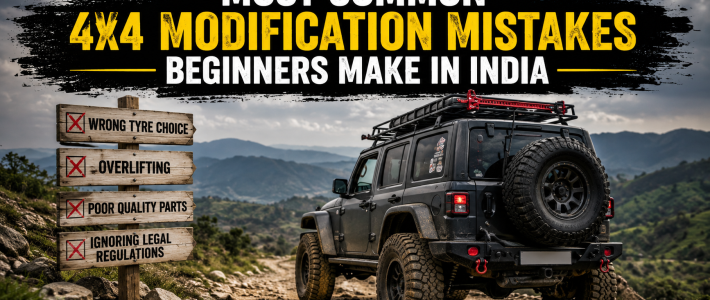
The most common 4x4 modification mistakes beginners make are fitting oversized tyres without suspension or gear ratio correction, choosing lift kits without matching them to actual usage, skipping underbody protection, and building purely for aesthetics without addressing safety systems. Here is each mistake in detail, with the Indian-specific context that makes it relevant.
1. Overloading with Unnecessary Accessories
The first mistake is the most visible: loading the vehicle with a roof tent, light bar, roof rack, spare tyre carrier, rear bumper, front winch bumper, snorkel, and side steps — all at once. Each item adds weight. Together, they add hundreds of kilograms above and around the vehicle's original centre of gravity.
The Mahindra Thar's payload budget — the difference between kerb weight and Gross Vehicle Weight — ranges from approximately 500 to 680 kg depending on variant and body style. That budget must cover driver, passengers, fuel, luggage, and recovery gear in addition to accessories. A full accessory load of 100–150 kg, on a vehicle already carrying passengers and trail equipment, reduces performance, stresses suspension components, and degrades fuel economy in a way that accumulates over time. Add modifications with a clear functional purpose, in sequence, with an honest weight audit before each addition.
2. Choosing the Wrong Suspension Setup
A lift kit is not a single product. It is a system — springs, shock absorbers, castor correction, trackbar, and alignment — that must be matched to the vehicle's usage, tyre size, and load. A beginner who installs a 3-inch lift without correcting castor geometry on the Thar ends up with steering shimmy, accelerated tyre wear, and a vehicle that handles worse on-road than stock.
For most recreational off-road builds in India, a 40–50 mm lift is appropriate on the Thar and Hilux. Anything beyond that requires driveshaft angle corrections, CV joint upgrades, and, on the Hilux, potentially differential drop spacers. Quality lift kits from brands like Ironman 4x4, Profender, and Tough Dog are available in India with appropriate component matching — but even quality products create problems when installed without a full alignment and geometry correction. This is the step most shops skip and most owners do not know what to ask for.
3. Incorrect Tyre and Wheel Selection
The single most disruptive off-road modification mistake in India is fitting tyres that are too large for the vehicle's current suspension and gear ratio setup. A 265/70 R17 fitted on a stock Thar sits at the limit of practical clearance. Jumping to 285/75 R16 (approximately 33 inches) without a suspension lift produces constant tyre-to-body contact, accelerated wheel arch wear, and a turning radius restriction that makes city driving impractical.
Terrain matching matters equally. An All-Terrain (AT) tyre — such as the BFGoodrich All-Terrain T/A KO2 or the Yokohama Geolandar AT G015 — covers 80–90% of Indian 4x4 use cases: mixed highway and trail. Mud Terrain (MT) tyres deliver trail capability at the cost of significant road noise, reduced wet-tarmac grip, and faster wear on Indian highways. Most beginner owners who fit MTs on their daily-driven Thar regret the decision within three months of regular highway use.
4. Ignoring Drivetrain and Gear Ratio Changes
When you fit a tyre significantly larger than the factory size, the vehicle's effective gear ratio changes. The engine and transmission are now pulling more tyre circumference per revolution. On a diesel Thar or Hilux, this manifests as sluggishness in low-end pull, the turbo working harder under load, and reduced highway fuel efficiency. On a petrol Thar, the effect on an already relaxed engine is more pronounced.
The solution — differential re-gearing or a transfer case ratio correction — is rarely discussed in beginner build content because it is expensive and invisible. Nobody photographs a differential regear for Instagram. But skipping this step on a build with significant tyre upsizing is a mechanical penalty paid every time the vehicle moves. A 4x4 modification cost India calculation that excludes gear ratio correction on a large-tyre build is missing a material line item.
5. Skipping Essential Protection Modifications
Underbody protection is the safety net of off road modification and the category most commonly deferred in favour of visual accessories. Skid plates protect the sump, gearbox, fuel tank, and differential from rock strikes that happen at low speed on technical terrain — the kind of sudden impact that a rock slider or sump guard absorbs entirely.
On Indian trails in Coorg, the Aravalli foothills, or the rock gardens of Tamil Nadu, sub-axle rock contact is common. A quality sump guard and rock slider set costs approximately ₹30,000–₹60,000 fitted — a fraction of the repair cost for a cracked oil sump or a bent fuel tank. Underbody protection is the modification that should come before the roof tent, the light bar, and the aftermarket bumper.
6. Neglecting Brakes and Safety Systems
Bigger, heavier tyres increase stopping distance. A stock 4x4 braking system is calibrated to stop the vehicle at factory weight with factory tyres. Adding 80 kg of accessories, fitting larger tyres, and mounting a steel bull bar that adds 25 kg to the front end changes the stopping physics in a way that is not optional to ignore.
Brake pad and rotor upgrades are available for both the Thar and Hilux. The practical test is simple: if the vehicle is heavier, running larger tyres, and operating at highway speeds, the braking system needs to be assessed against the new operating parameters. A beginner operating a heavily accessorised Thar at 100 km/h on NH44 without brake system attention has created a safety risk that the best off road modifications elsewhere in the build cannot compensate for.
7. Poor Planning and Budgeting
Half-built 4x4s are a common sight in the Indian off-road community. The pattern is consistent: tyres are fitted first, then the owner discovers the suspension needs upgrading to clear them, then realises the brakes should have come before the lift, then finds the roof rack has stressed the side steps that were not rated for the combined load. The build ends up over budget with each stage creating problems the next stage must fix.
A practical staged budget framework for 4x4 modification cost India builds:
• Stage 1 — Foundation (₹60,000–₹1,00,000): Sump guard, rock sliders, AT tyres matched to current suspension, basic recovery gear (snatch strap, D-shackles, hi-lift jack).
• Stage 2 — Suspension (₹80,000–₹1,50,000): Quality lift kit with geometry correction, brake pad/rotor upgrade if tyre size has materially increased.
• Stage 3 — Accessories (₹1,00,000–₹3,00,000): Lighting, steel bumpers, winch, roof rack, communication equipment — added after the mechanical foundation is correct.
Source: Cost ranges compiled from Jeep Clinic India (Oct 2025), Jeepclub.in build guides, and Futurz4x4 product pricing. Actual costs vary by brand, installer, and vehicle variant.
8. DIY Installation Without Expertise
YouTube has made every modification appear deceptively simple. In reality, suspension installation on a leaf-spring rear (Hilux) or torsion-bar front (Thar petrol variant) requires torque specifications, geometry tools, and the expertise to recognise when a component is not seating correctly. A misaligned trackbar on the Thar, or a suspension bolt hand-tightened rather than torque-wrench secured, creates failure conditions that announce themselves on a trail 400 km from the nearest 4x4 workshop.
Electrical modifications — additional lighting, dual-battery systems, winch wiring — carry fire risk when installed incorrectly. Amateur wiring with underspecified wire gauge, missing fuses, or improper earthing is a documented cause of vehicle fires in modified 4x4s. The hidden cost of a DIY error in this category is not the cost of the failed component — it is the cost of everything around it.
9. Ignoring Maintenance After Modifications
A modified 4x4 needs a modified maintenance schedule. Lift kits introduce new articulation points — extended brake lines under increased stress, steering tie rods at new angles, driveshafts operating at geometry the factory did not specify — that require inspection intervals shorter than the standard service schedule. A Thar running on AT tyres should be rotated every 7,000–8,000 km rather than the standard 10,000 km interval, because uneven wear develops faster on larger tyres with altered suspension geometry.
Differential and gearbox oil changes should be brought forward after trail use, particularly after water crossings where seal integrity may have been tested. Contaminated differential oil is a silent drivetrain component killer that shows no warning light until the damage is done.
10. Not Testing the Vehicle After Modifications
The build is complete. Before any trail run, the next step is a structured test phase — in a controlled, low-speed environment where handling changes are observable at manageable speeds. A newly lifted Thar has different body roll characteristics, a higher roll centre, and different steering feel than the stock vehicle. Discovering these changes at 80 km/h on a state highway is not an appropriate testing context.
A proper post-modification checkout includes a full alignment check at a 4x4-competent alignment shop, a braking test in a safe open area, and low-speed articulation testing before the first trail exposure. This is also the point at which any installer error surfaces — while the vehicle is in a controlled environment, not in the middle of a Coorg trail with the next vehicle 20 minutes behind.
Mistakes Specific to Popular 4x4 Vehicles in India
Mahindra Thar
The Thar's greatest modification vulnerability is its compact wheelbase — 2,450 mm on the 2-door — which makes it sensitive to lift-height and tyre-size combinations that would be stable on a longer-wheelbase vehicle. The most common Thar-specific mistake is a 3-inch lift combined with 33-inch tyres, simultaneously, on a vehicle without castor correction. The result: severe tramline on highways and shimmy at cruising speed.
The second Thar pattern is excessive roof loading — a roof tent plus light bar plus rack plus a jerry can mount — on a vehicle where the 2-door open-top design makes the combination disproportionately risky on sidehill terrain. Over-lifting and poor weight balance are the two Thar-specific off-road modification mistakes that most consistently appear in build troubleshooting discussions across Indian 4x4 communities.
Explore Mahindra Thar accessories and modification parts https://swastikfabs.in/mahindra-thar-accessories
Toyota Hilux
The most frequent toyota hilux modification india mistake is front-end weight concentration. A steel winch bumper, dual-recovery winch, and light bar mounted at the front of a Hilux adds 80–100 kg ahead of the front axle. Without balancing rear end weight distribution — or upgrading front springs to handle the additional load — this configuration causes front spring sag, reduced forward ground clearance, and altered approach angles that defeat the purpose of the lift.
The second Hilux mistake specific to Indian use is skipping the snorkel on a vehicle taken through water crossings. The Hilux's standard air intake is positioned low enough that a sustained river crossing above door-sill depth creates a genuine intake ingestion risk. A snorkel fitted to the Hilux — costing approximately ₹18,000–₹25,000 fitted — is a functional requirement for water crossing, not an aesthetic addition. The cost of a hydrolock repair on the Hilux's 2.8L turbo diesel runs into several lakh rupees.
Explore Toyota Hilux accessories and modification parts https://swastikfabs.in/toyota-hilux-accessories
Fortuner / Jimny
The Toyota Fortuner carries a common tyre mistake: fitting mud terrain tyres on a vehicle primarily used on-road. The Fortuner's highway-biased ride quality and its wider, family-use case make MT fitment a poor daily trade-off. AT tyres with a 1–1.5-inch spacer lift represent the practical balance for most Indian Fortuner use cases — adequate trail capability without the noise and wear penalty of MTs.
The Maruti Suzuki Jimny's compact dimensions make it particularly vulnerable to over-lifting. A 2-inch lift on the Jimny brings the centre of gravity high enough relative to its narrow track width to create roll angles that beginners underestimate on sidehill terrain. The Jimny should be upgraded conservatively — 1–1.5 inches maximum — with AT tyres and rock sliders as the priority. The Jimny's greatest asset is its size and agility; over-lifting works against both.
Explore Fortuner / Jimny accessories and modification parts https://swastikfabs.in/toyota-fortuner-accessories and https://swastikfabs.in/suzuki-jimny-accessories
How to Plan Your 4x4 Modifications the Right Way
3 questions to answer before approaching any modification shop
1. What percentage of my driving is highway/city versus trail — and what trail type (rock, mud, sand, water crossing)?
2. Is this vehicle a dedicated trail rig or a daily driver that also goes off-road?
3. What is my realistic per-stage budget — not my total aspirational budget?
A vehicle used 85% on-road and 15% on easy forest trails needs a fundamentally different specification than a dedicated Spiti expedition build. The modification plan for a daily-driven Thar in Bengaluru is AT tyres, sump protection, and a modest 40 mm lift. The plan for a Hilux going on extended Himalayan expeditions involves a snorkel, long-range fuel capacity, and a high-quality winch with appropriate anchoring options. These are different vehicles with the same nameplate.
The stage-by-stage approach — the only framework that consistently works
Stage 1 — Protection and capability foundation:
• AT tyres matched to current or lightly lifted suspension (within manufacturer size tolerance)
• Sump guard, transfer case skid plate, fuel tank skid plate
• Rock sliders on both sides
• Basic recovery kit: snatch strap, D-shackles, hi-lift jack, gloves, shovel
Stage 2 — Suspension and safety:
• Quality lift kit (40–50 mm for most Indian use cases) with geometry correction and alignment
• Brake pad and rotor assessment — upgrade if tyre size has increased significantly
• Extended brake lines if the lift height requires it
Stage 3 — Accessories (after mechanical foundation is established):
• Roof rack and lighting — with load capacity checked against suspension rating
• Winch and steel bumper — front and rear weight balance considered
• Communication equipment, dual battery, and auxiliary systems
Pre-modification checklist
• Terrain type (rock / mud / sand / water / mixed highway)
• Usage split — on-road percentage versus trail percentage
• Budget per stage — not total project estimate
• Compatibility with your specific vehicle variant (Thar petrol/diesel specs differ)
• Installer experience with your specific platform — ask to see previous builds
• RTO compliance confirmation for planned modifications
• Insurance provider notification before significant modifications are installed
Budget vs Performance — Where Beginners Go Wrong
The budget mistake in Indian 4x4 modification is not always overspending — it is often misallocated spending. Cheap suspension components cause the most expensive failures. A ₹15,000 lift kit from an unknown importer versus a ₹55,000 Ironman 4x4 kit is not a ₹40,000 saving. It is a ₹40,000 downpayment on premature failure, alignment problems, and potentially a dangerous situation on a trail 400 km from the nearest competent 4x4 workshop.
Counterintuitively, the best off road modifications by value are the unglamorous ones: recovery gear, sump protection, and all-terrain tyres. These three categories directly reduce the probability of expensive recoveries, drivetrain damage, and being stranded. A ₹30,000 investment in recovery gear and sump protection delivers more practical value on a trail than ₹30,000 of additional lighting.
Where to spend premium budget: Suspension (quality is directly safety-related), recovery equipment (winch working load rating should not be underspecified), and braking upgrades.
Where practical-grade products are acceptable: Roof racks from established Indian fabricators, tent mounts, auxiliary lighting with proper wiring kits, interior accessories.
Legal, Insurance and Warranty Mistakes in India
The Motor Vehicles Act framework
Vehicle modifications in India are governed primarily by Section 52 of the Motor Vehicles Act, 1988, which defines the conditions under which alterations to a registered vehicle are permitted. The central principle is that a vehicle must remain within manufacturer specifications unless the modification has been approved by the Regional Transport Office. Structural changes — chassis modifications, body extensions, engine alterations — require certification from authorised testing centres. All modifications that change the vehicle's registered specifications must be reported to the RTO within 14 days under Section 52.
Section 182A of the Motor Vehicles Act imposes penalties for non-compliance with safety and environmental standards, with fines reaching ₹10,000 for repeat violations. A structural modification not approved or disclosed to the RTO — including significant lift kits beyond manufacturer specification, chassis-mounted accessories, or non-standard tyre sizes that alter the vehicle's dimensional registration — creates a legal liability borne entirely by the owner.
Source: Motor Vehicles Act, 1988, Sections 52 and 182A — available at indiacode.nic.in. Consult your local RTO for state-specific interpretations.
What is prohibited under CMVR guidelines
• Chassis modifications or cuts require testing centre certification before installation
• Bull bars with sharp protrusions are prohibited — a Supreme Court order has specifically addressed this
• Army Green paint is prohibited for civilian vehicles
• Engine modifications must comply with applicable Bharat Stage emission standards (currently BS6 Phase 2 for new vehicles)
• Oversized tyres that materially alter the vehicle's dimensional specifications require RTO endorsement before use on public roads
Insurance implications
An undisclosed modification — a lift kit fitted without informing the insurance provider — can become grounds for claim rejection in the event of an accident where the modification is relevant to causation. An insurer assessing a rollover claim on a Thar fitted with an undisclosed 3-inch lift and 33-inch tyres has legitimate grounds to argue material non-disclosure of a risk-altering change.
The practical step is to inform your insurer of any significant modification and obtain written acknowledgement. Some insurers offer endorsements for modified vehicles. An unendorsed significant modification is an uninsured risk — not a technicality but a financial exposure the owner absorbs in the event of a claim.
Manufacturer warranty
Suspension lift kits, non-OEM wheels, and accessories that alter the vehicle's structural or mechanical configuration void the manufacturer warranty on the affected systems. Mahindra's warranty terms, as with most Indian manufacturers, specify that modifications to suspension, drivetrain, and structural components void the warranty on those components and potentially on related systems. Understanding this before the first installation prevents later disputes with the dealership when a warranty claim is declined.
DIY vs Professional Installation — What You Should Choose
The hidden cost of a DIY suspension error is rarely immediate. It appears at the 5,000 km mark as accelerated inner tyre wear, at the 15,000 km mark as worn ball joints, and potentially on a trail as a component failure under load. The repair cost of professional remediation of a DIY suspension installation consistently exceeds the cost of professional installation in the first place.
Choose professional installation for any modification that affects vehicle dynamics, electrical load capacity, or structural integrity. Choose a shop experienced specifically with your vehicle platform — not a general workshop willing to attempt an unfamiliar build.
Real-World Examples — Mistakes in Indian Off-Roading
Coorg trail — the heavy-front Thar
A Thar owner from Mysuru drives to Coorg for a weekend trail with a 3-inch lift, 33-inch MT tyres, a full steel front bumper with a winch, and a roof rack carrying camping gear. The combination — heavy front end, high centre of gravity, aggressive mud rubber on wet laterite — produces exactly the handling character that catches beginners: nose-heavy balance, poor wet-rock grip from the MTs despite their aggressive tread pattern, and roof rack pendulum motion on sidehill sections that was absent on the stock vehicle. No incident occurs, but the driver is overtaken on every technical section by a stock Thar on ATs fitted by an experienced owner who built in the correct sequence.
Ladakh expedition — the snorkel-less Hilux
A Hilux owner sets out on a Leh–Manali–Spiti circuit with a winch bumper, light bar, and roof tent — but no skid plates, no snorkel, and stock all-season tyres. The approach to Rohtang La involves stream crossings that reach door-sill height. The stock air intake ingests moisture and the engine hydrolocks 90 km from Manali. The repair — a top-end rebuild on the 2.8L turbo diesel — is expensive and takes several days, stranding the expedition until parts and transport can be arranged. A snorkel costs approximately ₹18,000–₹25,000 fitted. The price difference is material.
Chennai highway — the Jimny with MT tyres
A Jimny owner in Chennai fits 16-inch aftermarket wheels with 245/70 mud terrain tyres and a 2-inch spacer lift for aesthetics. On the Chennai–Trichy highway, the MT tyres generate constant drone that makes long-distance driving uncomfortable, fuel consumption rises noticeably, and tyre wear at 12,000 km shows shoulder-heavy patterns from the altered geometry. The owner returns to appropriate AT tyres before 15,000 km, having absorbed the cost of two tyre sets, mounting, and alignment on a vehicle that did not visit a single trail.
These scenarios represent composite patterns that appear repeatedly across Indian 4x4 owner communities and forums — not individual incidents. Specific driver names and dates are composites for illustrative purposes.
How to Avoid These 4x4 Modification Mistakes — Beginner Checklist
The following checklist applies before any modification purchase, before any installer conversation, and before any trail run on a newly modified vehicle.
Before buying any modification:
1. Define actual terrain type and usage split — write it down, not just think it through
2. Research compatibility for your specific vehicle variant (engine type, year, body style)
3. Set a per-stage budget — not a single total project figure
4. Identify a professional installer with documented experience on your platform
5. Confirm RTO compliance status of each planned modification
6. Notify your insurance provider of any planned significant modification
Correct modification sequence:
1. Protection first — sump guard, rock sliders
2. Tyres — AT size within current suspension clearance
3. Suspension — quality lift with full geometry correction
4. Safety — brake assessment and upgrade if required
5. Accessories — only after mechanical foundation is established and tested
After every modification:
1. Full alignment check at a 4x4-competent workshop
2. Post-mod brake test in a safe, open area before trail use
3. Update maintenance schedule to shorter intervals than factory spec
4. Document all modifications for insurance and RTO purposes
Why Choose Swastik Fabs for 4x4 Modifications
Swastik Fabs operates as a specialist off-road fabrication and modification shop with vehicle-specific build experience across the Mahindra Thar, Toyota Hilux, Isuzu D-Max V-Cross, and Suzuki Jimny. The distinction between a specialist and a general auto workshop lies in platform-specific knowledge — the exact geometry correction procedure for the 2020 Thar's torsion bar front, the driveshaft angles on a Hilux after a 50 mm lift, the appropriate electrical specification for a dual-battery system that will not create a fire risk.
Every Swastik Fabs consultation begins with a usage brief, not a product catalogue. Modification sequence and specification are defined by how and where the vehicle will actually be used — not by what builds perform well on social media. Builds are completed with proper geometry correction, post-installation alignment, and functional testing before handover.
For a build consultation, visit swastikfabs.in or contact the Swastik Fabs team directly to discuss your vehicle, usage, and build goals.
Conclusion — Build Smart, Not Just Aggressive
The common thread running through every 4x4 modification mistake covered in this article is the same: the decision was made visually rather than functionally. The wrong tyre was visually impressive. The skipped skid plate freed the budget for something more photogenic. The DIY suspension saved labour costs and created a mechanical liability the owner carried for 15,000 km before it became a visible problem.
The builds that last, perform consistently on Indian terrain, and remain legal and insured are built around a usage definition rather than a social media aesthetic. Start with protection and appropriate tyres. Build suspension on that foundation. Add accessories after the vehicle's mechanical behaviour has been established and tested.
These are beginner off-road mistakes that are entirely avoidable with sequence, planning, and a competent installer. The cost of getting this right is lower than the cost of getting it wrong — in money, in time, and on the trail when a build failure is 200 km from any help.
Ready to build correctly? Consult the team at Swastik Fabs — vehicle-specific builds, professional installation, and guidance from the first tyre choice to the final accessory fitment.
Frequently Asked Questions About 4x4 Modification Mistakes in India
The most common 4x4 modification mistakes are fitting oversized tyres without suspension or gear ratio correction, skipping underbody protection, installing lift kits without geometry correction, DIY installation of suspension systems, and building for social media aesthetics rather than terrain-specific functionality. In India specifically, ignoring RTO compliance and insurance notification are compounding mistakes that create legal and financial exposure.
Both are well-supported platforms in India's aftermarket. The Thar's compact wheelbase suits technical trail agility and is ideal for the Western Ghats, Aravalli foothills, and rocky terrain. The Hilux offers greater payload capacity and suits longer expedition-style builds for Ladakh, Spiti, and overland routes. The better choice depends entirely on usage — trail agility versus payload and distance.
Yes. Modifications to suspension, drivetrain, and structural components void the manufacturer warranty on those systems and potentially on related components. Under Motor Vehicles Act Section 52, significant modifications must be disclosed to the RTO within 14 days. Insurance providers must be notified separately — an undisclosed modification that is relevant to an accident claim can result in claim rejection.
Start with underbody protection — sump guard and rock sliders — and the correct AT tyre size for your current suspension clearance. These two modifications improve trail capability and reduce the probability of expensive damage without creating new mechanical or handling issues. Quality suspension lift with geometry correction follows as Stage 2, after the protection foundation is in place.
Simple bolt-on accessories — roof racks, auxiliary lighting with a proper wiring kit, recovery gear mounting, bolt-on skid plates — can be DIY with mechanical competence. Suspension systems, winch wiring, snorkels, and differential lockers must be handled by a specialist. The cost of professionally remedying a DIY suspension installation consistently exceeds the cost of professional installation to begin with.
Introduction
The first few months after buying a Mahindra Thar or Toyota Hilux follow a predictable pattern for most new owners in India. Instagram reels of Coorg trail runs and Spiti expedition builds start filling the feed. WhatsApp group members suggest lifts, tyres, light bars, and bumpers — sometimes all at once. The excitement is real. So is the financial damage that follows when that excitement drives the build instead of a plan.
The Indian 4x4 community has grown significantly since the second-generation Thar's 2020 relaunch and the Hilux's India debut in 2022. With that growth comes a larger pool of first-time builders who discover the hard way that an off road modification that works on a YouTube build filmed in Arizona does not automatically translate to a Bandipur forest trail or a monsoon-flooded village road in Coorg. Indian terrain, Indian fuel quality, Indian service infrastructure, and Indian driving patterns create a modification context that global 4x4 content largely ignores.
The 4x4 modification mistakes covered in this guide are drawn from real-world build patterns across India — wrong lift specs, ignored gear ratios, skipped skid plates, and regulatory surprises that cost owners money, performance, and legal standing. Whether you are at the research stage or already mid-build, reading this before the next purchase decision can save a significant amount of both money and time.
Why Beginners Make 4x4 Modification Mistakes in India
Lack of a defined usage plan
Most beginner builds start with a visual target — a build photo or a YouTube walkthrough — rather than a usage definition. A 4x4 used primarily for Bengaluru city driving with two weekend off-road runs per year needs a completely different modification priority list than one going on a Ladakh expedition every summer. The absence of a usage plan is the root cause of most beginner off-road mistakes encountered in the Indian 4x4 community.
Social media builds designed for other markets
The global 4x4 modification content circulating on YouTube and Instagram is largely built for Australian, American, and South African terrains — markets where tyre sizes, fuel quality, service infrastructure, and road conditions differ substantially from India. A 35-inch tyre build that works in the Australian Outback may deliver nothing but rubbing, fuel penalty, and strained CV joints on Indian mixed-terrain driving.
Ignoring Indian terrain and daily usage realities
India's 4x4 terrain covers extreme variety — Ladakh's loose rocky altitude, Kerala's laterite and monsoon mud, Rajasthan's sand, the Western Ghats' slippery wet rock and root. The vast majority of Indian 4x4 owners, however, drive 80–90% of the time on tarmac — city roads, national highways, and state roads. Modifications that hurt on-road behaviour in the name of trail capability create daily discomfort for owners who trail-drive a handful of weekends per year.
Budget pressure driving incomplete builds
Modifying in half-steps because of budget constraints — fitting oversized tyres without recalibrating gear ratios, adding a roof rack without reinforcing suspension — creates vehicles that are more capable on paper than in practice. A half-built 4x4 is often harder to fix than starting fresh.
10 Most Common 4x4 Modification Mistakes Beginners Make
The most common 4x4 modification mistakes beginners make are fitting oversized tyres without suspension or gear ratio correction, choosing lift kits without matching them to actual usage, skipping underbody protection, and building purely for aesthetics without addressing safety systems. Here is each mistake in detail, with the Indian-specific context that makes it relevant.
1. Overloading with Unnecessary Accessories
The first mistake is the most visible: loading the vehicle with a roof tent, light bar, roof rack, spare tyre carrier, rear bumper, front winch bumper, snorkel, and side steps — all at once. Each item adds weight. Together, they add hundreds of kilograms above and around the vehicle's original centre of gravity.
The Mahindra Thar's payload budget — the difference between kerb weight and Gross Vehicle Weight — ranges from approximately 500 to 680 kg depending on variant and body style. That budget must cover driver, passengers, fuel, luggage, and recovery gear in addition to accessories. A full accessory load of 100–150 kg, on a vehicle already carrying passengers and trail equipment, reduces performance, stresses suspension components, and degrades fuel economy in a way that accumulates over time. Add modifications with a clear functional purpose, in sequence, with an honest weight audit before each addition.
2. Choosing the Wrong Suspension Setup
A lift kit is not a single product. It is a system — springs, shock absorbers, castor correction, trackbar, and alignment — that must be matched to the vehicle's usage, tyre size, and load. A beginner who installs a 3-inch lift without correcting castor geometry on the Thar ends up with steering shimmy, accelerated tyre wear, and a vehicle that handles worse on-road than stock.
For most recreational off-road builds in India, a 40–50 mm lift is appropriate on the Thar and Hilux. Anything beyond that requires driveshaft angle corrections, CV joint upgrades, and, on the Hilux, potentially differential drop spacers. Quality lift kits from brands like Ironman 4x4, Profender, and Tough Dog are available in India with appropriate component matching — but even quality products create problems when installed without a full alignment and geometry correction. This is the step most shops skip and most owners do not know what to ask for.
3. Incorrect Tyre and Wheel Selection
The single most disruptive off-road modification mistake in India is fitting tyres that are too large for the vehicle's current suspension and gear ratio setup. A 265/70 R17 fitted on a stock Thar sits at the limit of practical clearance. Jumping to 285/75 R16 (approximately 33 inches) without a suspension lift produces constant tyre-to-body contact, accelerated wheel arch wear, and a turning radius restriction that makes city driving impractical.
Terrain matching matters equally. An All-Terrain (AT) tyre — such as the BFGoodrich All-Terrain T/A KO2 or the Yokohama Geolandar AT G015 — covers 80–90% of Indian 4x4 use cases: mixed highway and trail. Mud Terrain (MT) tyres deliver trail capability at the cost of significant road noise, reduced wet-tarmac grip, and faster wear on Indian highways. Most beginner owners who fit MTs on their daily-driven Thar regret the decision within three months of regular highway use.
4. Ignoring Drivetrain and Gear Ratio Changes
When you fit a tyre significantly larger than the factory size, the vehicle's effective gear ratio changes. The engine and transmission are now pulling more tyre circumference per revolution. On a diesel Thar or Hilux, this manifests as sluggishness in low-end pull, the turbo working harder under load, and reduced highway fuel efficiency. On a petrol Thar, the effect on an already relaxed engine is more pronounced.
The solution — differential re-gearing or a transfer case ratio correction — is rarely discussed in beginner build content because it is expensive and invisible. Nobody photographs a differential regear for Instagram. But skipping this step on a build with significant tyre upsizing is a mechanical penalty paid every time the vehicle moves. A 4x4 modification cost India calculation that excludes gear ratio correction on a large-tyre build is missing a material line item.
5. Skipping Essential Protection Modifications
Underbody protection is the safety net of off road modification and the category most commonly deferred in favour of visual accessories. Skid plates protect the sump, gearbox, fuel tank, and differential from rock strikes that happen at low speed on technical terrain — the kind of sudden impact that a rock slider or sump guard absorbs entirely.
On Indian trails in Coorg, the Aravalli foothills, or the rock gardens of Tamil Nadu, sub-axle rock contact is common. A quality sump guard and rock slider set costs approximately ₹30,000–₹60,000 fitted — a fraction of the repair cost for a cracked oil sump or a bent fuel tank. Underbody protection is the modification that should come before the roof tent, the light bar, and the aftermarket bumper.
6. Neglecting Brakes and Safety Systems
Bigger, heavier tyres increase stopping distance. A stock 4x4 braking system is calibrated to stop the vehicle at factory weight with factory tyres. Adding 80 kg of accessories, fitting larger tyres, and mounting a steel bull bar that adds 25 kg to the front end changes the stopping physics in a way that is not optional to ignore.
Brake pad and rotor upgrades are available for both the Thar and Hilux. The practical test is simple: if the vehicle is heavier, running larger tyres, and operating at highway speeds, the braking system needs to be assessed against the new operating parameters. A beginner operating a heavily accessorised Thar at 100 km/h on NH44 without brake system attention has created a safety risk that the best off road modifications elsewhere in the build cannot compensate for.
7. Poor Planning and Budgeting
Half-built 4x4s are a common sight in the Indian off-road community. The pattern is consistent: tyres are fitted first, then the owner discovers the suspension needs upgrading to clear them, then realises the brakes should have come before the lift, then finds the roof rack has stressed the side steps that were not rated for the combined load. The build ends up over budget with each stage creating problems the next stage must fix.
A practical staged budget framework for 4x4 modification cost India builds:
• Stage 1 — Foundation (₹60,000–₹1,00,000): Sump guard, rock sliders, AT tyres matched to current suspension, basic recovery gear (snatch strap, D-shackles, hi-lift jack).
• Stage 2 — Suspension (₹80,000–₹1,50,000): Quality lift kit with geometry correction, brake pad/rotor upgrade if tyre size has materially increased.
• Stage 3 — Accessories (₹1,00,000–₹3,00,000): Lighting, steel bumpers, winch, roof rack, communication equipment — added after the mechanical foundation is correct.
Source: Cost ranges compiled from Jeep Clinic India (Oct 2025), Jeepclub.in build guides, and Futurz4x4 product pricing. Actual costs vary by brand, installer, and vehicle variant.
8. DIY Installation Without Expertise
YouTube has made every modification appear deceptively simple. In reality, suspension installation on a leaf-spring rear (Hilux) or torsion-bar front (Thar petrol variant) requires torque specifications, geometry tools, and the expertise to recognise when a component is not seating correctly. A misaligned trackbar on the Thar, or a suspension bolt hand-tightened rather than torque-wrench secured, creates failure conditions that announce themselves on a trail 400 km from the nearest 4x4 workshop.
Electrical modifications — additional lighting, dual-battery systems, winch wiring — carry fire risk when installed incorrectly. Amateur wiring with underspecified wire gauge, missing fuses, or improper earthing is a documented cause of vehicle fires in modified 4x4s. The hidden cost of a DIY error in this category is not the cost of the failed component — it is the cost of everything around it.
9. Ignoring Maintenance After Modifications
A modified 4x4 needs a modified maintenance schedule. Lift kits introduce new articulation points — extended brake lines under increased stress, steering tie rods at new angles, driveshafts operating at geometry the factory did not specify — that require inspection intervals shorter than the standard service schedule. A Thar running on AT tyres should be rotated every 7,000–8,000 km rather than the standard 10,000 km interval, because uneven wear develops faster on larger tyres with altered suspension geometry.
Differential and gearbox oil changes should be brought forward after trail use, particularly after water crossings where seal integrity may have been tested. Contaminated differential oil is a silent drivetrain component killer that shows no warning light until the damage is done.
10. Not Testing the Vehicle After Modifications
The build is complete. Before any trail run, the next step is a structured test phase — in a controlled, low-speed environment where handling changes are observable at manageable speeds. A newly lifted Thar has different body roll characteristics, a higher roll centre, and different steering feel than the stock vehicle. Discovering these changes at 80 km/h on a state highway is not an appropriate testing context.
A proper post-modification checkout includes a full alignment check at a 4x4-competent alignment shop, a braking test in a safe open area, and low-speed articulation testing before the first trail exposure. This is also the point at which any installer error surfaces — while the vehicle is in a controlled environment, not in the middle of a Coorg trail with the next vehicle 20 minutes behind.
Mistakes Specific to Popular 4x4 Vehicles in India
Mahindra Thar
The Thar's greatest modification vulnerability is its compact wheelbase — 2,450 mm on the 2-door — which makes it sensitive to lift-height and tyre-size combinations that would be stable on a longer-wheelbase vehicle. The most common Thar-specific mistake is a 3-inch lift combined with 33-inch tyres, simultaneously, on a vehicle without castor correction. The result: severe tramline on highways and shimmy at cruising speed.
The second Thar pattern is excessive roof loading — a roof tent plus light bar plus rack plus a jerry can mount — on a vehicle where the 2-door open-top design makes the combination disproportionately risky on sidehill terrain. Over-lifting and poor weight balance are the two Thar-specific off-road modification mistakes that most consistently appear in build troubleshooting discussions across Indian 4x4 communities.
Explore Mahindra Thar accessories and modification parts https://swastikfabs.in/mahindra-thar-accessories
Toyota Hilux
The most frequent toyota hilux modification india mistake is front-end weight concentration. A steel winch bumper, dual-recovery winch, and light bar mounted at the front of a Hilux adds 80–100 kg ahead of the front axle. Without balancing rear end weight distribution — or upgrading front springs to handle the additional load — this configuration causes front spring sag, reduced forward ground clearance, and altered approach angles that defeat the purpose of the lift.
The second Hilux mistake specific to Indian use is skipping the snorkel on a vehicle taken through water crossings. The Hilux's standard air intake is positioned low enough that a sustained river crossing above door-sill depth creates a genuine intake ingestion risk. A snorkel fitted to the Hilux — costing approximately ₹18,000–₹25,000 fitted — is a functional requirement for water crossing, not an aesthetic addition. The cost of a hydrolock repair on the Hilux's 2.8L turbo diesel runs into several lakh rupees.
Explore Toyota Hilux accessories and modification parts https://swastikfabs.in/toyota-hilux-accessories
Fortuner / Jimny
The Toyota Fortuner carries a common tyre mistake: fitting mud terrain tyres on a vehicle primarily used on-road. The Fortuner's highway-biased ride quality and its wider, family-use case make MT fitment a poor daily trade-off. AT tyres with a 1–1.5-inch spacer lift represent the practical balance for most Indian Fortuner use cases — adequate trail capability without the noise and wear penalty of MTs.
The Maruti Suzuki Jimny's compact dimensions make it particularly vulnerable to over-lifting. A 2-inch lift on the Jimny brings the centre of gravity high enough relative to its narrow track width to create roll angles that beginners underestimate on sidehill terrain. The Jimny should be upgraded conservatively — 1–1.5 inches maximum — with AT tyres and rock sliders as the priority. The Jimny's greatest asset is its size and agility; over-lifting works against both.
Explore Fortuner / Jimny accessories and modification parts https://swastikfabs.in/toyota-fortuner-accessories and https://swastikfabs.in/suzuki-jimny-accessories
How to Plan Your 4x4 Modifications the Right Way
3 questions to answer before approaching any modification shop
1. What percentage of my driving is highway/city versus trail — and what trail type (rock, mud, sand, water crossing)?
2. Is this vehicle a dedicated trail rig or a daily driver that also goes off-road?
3. What is my realistic per-stage budget — not my total aspirational budget?
A vehicle used 85% on-road and 15% on easy forest trails needs a fundamentally different specification than a dedicated Spiti expedition build. The modification plan for a daily-driven Thar in Bengaluru is AT tyres, sump protection, and a modest 40 mm lift. The plan for a Hilux going on extended Himalayan expeditions involves a snorkel, long-range fuel capacity, and a high-quality winch with appropriate anchoring options. These are different vehicles with the same nameplate.
The stage-by-stage approach — the only framework that consistently works
Stage 1 — Protection and capability foundation:
• AT tyres matched to current or lightly lifted suspension (within manufacturer size tolerance)
• Sump guard, transfer case skid plate, fuel tank skid plate
• Rock sliders on both sides
• Basic recovery kit: snatch strap, D-shackles, hi-lift jack, gloves, shovel
Stage 2 — Suspension and safety:
• Quality lift kit (40–50 mm for most Indian use cases) with geometry correction and alignment
• Brake pad and rotor assessment — upgrade if tyre size has increased significantly
• Extended brake lines if the lift height requires it
Stage 3 — Accessories (after mechanical foundation is established):
• Roof rack and lighting — with load capacity checked against suspension rating
• Winch and steel bumper — front and rear weight balance considered
• Communication equipment, dual battery, and auxiliary systems
Pre-modification checklist
• Terrain type (rock / mud / sand / water / mixed highway)
• Usage split — on-road percentage versus trail percentage
• Budget per stage — not total project estimate
• Compatibility with your specific vehicle variant (Thar petrol/diesel specs differ)
• Installer experience with your specific platform — ask to see previous builds
• RTO compliance confirmation for planned modifications
• Insurance provider notification before significant modifications are installed
Budget vs Performance — Where Beginners Go Wrong
The budget mistake in Indian 4x4 modification is not always overspending — it is often misallocated spending. Cheap suspension components cause the most expensive failures. A ₹15,000 lift kit from an unknown importer versus a ₹55,000 Ironman 4x4 kit is not a ₹40,000 saving. It is a ₹40,000 downpayment on premature failure, alignment problems, and potentially a dangerous situation on a trail 400 km from the nearest competent 4x4 workshop.
Counterintuitively, the best off road modifications by value are the unglamorous ones: recovery gear, sump protection, and all-terrain tyres. These three categories directly reduce the probability of expensive recoveries, drivetrain damage, and being stranded. A ₹30,000 investment in recovery gear and sump protection delivers more practical value on a trail than ₹30,000 of additional lighting.
Where to spend premium budget: Suspension (quality is directly safety-related), recovery equipment (winch working load rating should not be underspecified), and braking upgrades.
Where practical-grade products are acceptable: Roof racks from established Indian fabricators, tent mounts, auxiliary lighting with proper wiring kits, interior accessories.
Legal, Insurance and Warranty Mistakes in India
The Motor Vehicles Act framework
Vehicle modifications in India are governed primarily by Section 52 of the Motor Vehicles Act, 1988, which defines the conditions under which alterations to a registered vehicle are permitted. The central principle is that a vehicle must remain within manufacturer specifications unless the modification has been approved by the Regional Transport Office. Structural changes — chassis modifications, body extensions, engine alterations — require certification from authorised testing centres. All modifications that change the vehicle's registered specifications must be reported to the RTO within 14 days under Section 52.
Section 182A of the Motor Vehicles Act imposes penalties for non-compliance with safety and environmental standards, with fines reaching ₹10,000 for repeat violations. A structural modification not approved or disclosed to the RTO — including significant lift kits beyond manufacturer specification, chassis-mounted accessories, or non-standard tyre sizes that alter the vehicle's dimensional registration — creates a legal liability borne entirely by the owner.
Source: Motor Vehicles Act, 1988, Sections 52 and 182A — available at indiacode.nic.in. Consult your local RTO for state-specific interpretations.
What is prohibited under CMVR guidelines
• Chassis modifications or cuts require testing centre certification before installation
• Bull bars with sharp protrusions are prohibited — a Supreme Court order has specifically addressed this
• Army Green paint is prohibited for civilian vehicles
• Engine modifications must comply with applicable Bharat Stage emission standards (currently BS6 Phase 2 for new vehicles)
• Oversized tyres that materially alter the vehicle's dimensional specifications require RTO endorsement before use on public roads
Insurance implications
An undisclosed modification — a lift kit fitted without informing the insurance provider — can become grounds for claim rejection in the event of an accident where the modification is relevant to causation. An insurer assessing a rollover claim on a Thar fitted with an undisclosed 3-inch lift and 33-inch tyres has legitimate grounds to argue material non-disclosure of a risk-altering change.
The practical step is to inform your insurer of any significant modification and obtain written acknowledgement. Some insurers offer endorsements for modified vehicles. An unendorsed significant modification is an uninsured risk — not a technicality but a financial exposure the owner absorbs in the event of a claim.
Manufacturer warranty
Suspension lift kits, non-OEM wheels, and accessories that alter the vehicle's structural or mechanical configuration void the manufacturer warranty on the affected systems. Mahindra's warranty terms, as with most Indian manufacturers, specify that modifications to suspension, drivetrain, and structural components void the warranty on those components and potentially on related systems. Understanding this before the first installation prevents later disputes with the dealership when a warranty claim is declined.
DIY vs Professional Installation — What You Should Choose
The hidden cost of a DIY suspension error is rarely immediate. It appears at the 5,000 km mark as accelerated inner tyre wear, at the 15,000 km mark as worn ball joints, and potentially on a trail as a component failure under load. The repair cost of professional remediation of a DIY suspension installation consistently exceeds the cost of professional installation in the first place.
Choose professional installation for any modification that affects vehicle dynamics, electrical load capacity, or structural integrity. Choose a shop experienced specifically with your vehicle platform — not a general workshop willing to attempt an unfamiliar build.
Real-World Examples — Mistakes in Indian Off-Roading
Coorg trail — the heavy-front Thar
A Thar owner from Mysuru drives to Coorg for a weekend trail with a 3-inch lift, 33-inch MT tyres, a full steel front bumper with a winch, and a roof rack carrying camping gear. The combination — heavy front end, high centre of gravity, aggressive mud rubber on wet laterite — produces exactly the handling character that catches beginners: nose-heavy balance, poor wet-rock grip from the MTs despite their aggressive tread pattern, and roof rack pendulum motion on sidehill sections that was absent on the stock vehicle. No incident occurs, but the driver is overtaken on every technical section by a stock Thar on ATs fitted by an experienced owner who built in the correct sequence.
Ladakh expedition — the snorkel-less Hilux
A Hilux owner sets out on a Leh–Manali–Spiti circuit with a winch bumper, light bar, and roof tent — but no skid plates, no snorkel, and stock all-season tyres. The approach to Rohtang La involves stream crossings that reach door-sill height. The stock air intake ingests moisture and the engine hydrolocks 90 km from Manali. The repair — a top-end rebuild on the 2.8L turbo diesel — is expensive and takes several days, stranding the expedition until parts and transport can be arranged. A snorkel costs approximately ₹18,000–₹25,000 fitted. The price difference is material.
Chennai highway — the Jimny with MT tyres
A Jimny owner in Chennai fits 16-inch aftermarket wheels with 245/70 mud terrain tyres and a 2-inch spacer lift for aesthetics. On the Chennai–Trichy highway, the MT tyres generate constant drone that makes long-distance driving uncomfortable, fuel consumption rises noticeably, and tyre wear at 12,000 km shows shoulder-heavy patterns from the altered geometry. The owner returns to appropriate AT tyres before 15,000 km, having absorbed the cost of two tyre sets, mounting, and alignment on a vehicle that did not visit a single trail.
These scenarios represent composite patterns that appear repeatedly across Indian 4x4 owner communities and forums — not individual incidents. Specific driver names and dates are composites for illustrative purposes.
How to Avoid These 4x4 Modification Mistakes — Beginner Checklist
The following checklist applies before any modification purchase, before any installer conversation, and before any trail run on a newly modified vehicle.
Before buying any modification:
1. Define actual terrain type and usage split — write it down, not just think it through
2. Research compatibility for your specific vehicle variant (engine type, year, body style)
3. Set a per-stage budget — not a single total project figure
4. Identify a professional installer with documented experience on your platform
5. Confirm RTO compliance status of each planned modification
6. Notify your insurance provider of any planned significant modification
Correct modification sequence:
1. Protection first — sump guard, rock sliders
2. Tyres — AT size within current suspension clearance
3. Suspension — quality lift with full geometry correction
4. Safety — brake assessment and upgrade if required
5. Accessories — only after mechanical foundation is established and tested
After every modification:
1. Full alignment check at a 4x4-competent workshop
2. Post-mod brake test in a safe, open area before trail use
3. Update maintenance schedule to shorter intervals than factory spec
4. Document all modifications for insurance and RTO purposes
Why Choose Swastik Fabs for 4x4 Modifications
Swastik Fabs operates as a specialist off-road fabrication and modification shop with vehicle-specific build experience across the Mahindra Thar, Toyota Hilux, Isuzu D-Max V-Cross, and Suzuki Jimny. The distinction between a specialist and a general auto workshop lies in platform-specific knowledge — the exact geometry correction procedure for the 2020 Thar's torsion bar front, the driveshaft angles on a Hilux after a 50 mm lift, the appropriate electrical specification for a dual-battery system that will not create a fire risk.
Every Swastik Fabs consultation begins with a usage brief, not a product catalogue. Modification sequence and specification are defined by how and where the vehicle will actually be used — not by what builds perform well on social media. Builds are completed with proper geometry correction, post-installation alignment, and functional testing before handover.
For a build consultation, visit swastikfabs.in or contact the Swastik Fabs team directly to discuss your vehicle, usage, and build goals.
Conclusion — Build Smart, Not Just Aggressive
The common thread running through every 4x4 modification mistake covered in this article is the same: the decision was made visually rather than functionally. The wrong tyre was visually impressive. The skipped skid plate freed the budget for something more photogenic. The DIY suspension saved labour costs and created a mechanical liability the owner carried for 15,000 km before it became a visible problem.
The builds that last, perform consistently on Indian terrain, and remain legal and insured are built around a usage definition rather than a social media aesthetic. Start with protection and appropriate tyres. Build suspension on that foundation. Add accessories after the vehicle's mechanical behaviour has been established and tested.
These are beginner off-road mistakes that are entirely avoidable with sequence, planning, and a competent installer. The cost of getting this right is lower than the cost of getting it wrong — in money, in time, and on the trail when a build failure is 200 km from any help.
Ready to build correctly? Consult the team at Swastik Fabs — vehicle-specific builds, professional installation, and guidance from the first tyre choice to the final accessory fitment.
Frequently Asked Questions About 4x4 Modification Mistakes in India
The most common 4x4 modification mistakes are fitting oversized tyres without suspension or gear ratio correction, skipping underbody protection, installing lift kits without geometry correction, DIY installation of suspension systems, and building for social media aesthetics rather than terrain-specific functionality. In India specifically, ignoring RTO compliance and insurance notification are compounding mistakes that create legal and financial exposure.
Both are well-supported platforms in India's aftermarket. The Thar's compact wheelbase suits technical trail agility and is ideal for the Western Ghats, Aravalli foothills, and rocky terrain. The Hilux offers greater payload capacity and suits longer expedition-style builds for Ladakh, Spiti, and overland routes. The better choice depends entirely on usage — trail agility versus payload and distance.
Yes. Modifications to suspension, drivetrain, and structural components void the manufacturer warranty on those systems and potentially on related components. Under Motor Vehicles Act Section 52, significant modifications must be disclosed to the RTO within 14 days. Insurance providers must be notified separately — an undisclosed modification that is relevant to an accident claim can result in claim rejection.
Start with underbody protection — sump guard and rock sliders — and the correct AT tyre size for your current suspension clearance. These two modifications improve trail capability and reduce the probability of expensive damage without creating new mechanical or handling issues. Quality suspension lift with geometry correction follows as Stage 2, after the protection foundation is in place.
Simple bolt-on accessories — roof racks, auxiliary lighting with a proper wiring kit, recovery gear mounting, bolt-on skid plates — can be DIY with mechanical competence. Suspension systems, winch wiring, snorkels, and differential lockers must be handled by a specialist. The cost of professionally remedying a DIY suspension installation consistently exceeds the cost of professional installation to begin with.
Leave a Comment